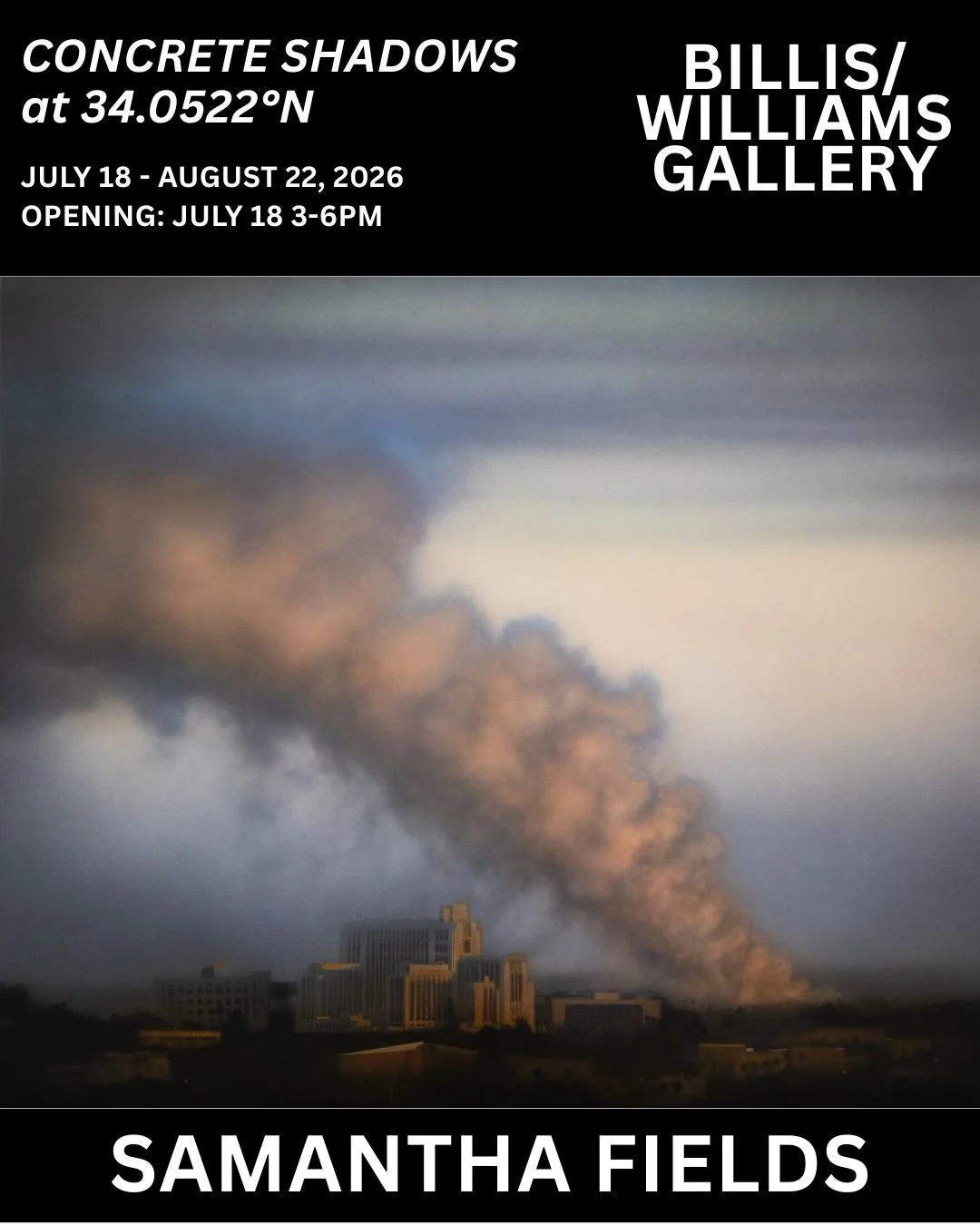
CONCRETE SHADOWS AT 34.0522°N
CITYSCAPE 2026
July 18 - August 22, 2026
Opening Reception: Saturday, July 18th, 3-6pm
Los Angeles is a city of paradoxes. The celluloid dreams and Hollywood glitter butted up against a housing crisis and massive homeless population. The unyielding desert landscape up against heavily watered lawns of Beverly Hills. A city filled with transplants who arrive in search of a place to reinvent themselves and follow their dreams and deeply rooted communities that have been here for generations. There is the quiet of deep snow in the Angeles National Forest and the roaring multi-level traffic flying by sky-high on cloverleaf interchange of the 110 and 105 freeways.
This year’s edition looks at the dichotomies of this city. Dichotomies that range from the mundane and intimate to the epic and iconic. Incongruous at times, the experience of Los Angeles is that of holding many truths simultaneously. The haves and the have-nots, decaying Art Deco theaters and gleaming experimental new architecture, dreams born and dreams dashed, the losses to fires and the rebirth of communities from those ashes.
There is a grit and intensity to this city. It is an unexpected crazy quilt comprised of unique communities, varied architecture, and microclimates connected by a maze of freeways and surface streets. Nature and the built cityscape, the idealized world of the entertainment industry against real people’s lives, the desert and the ocean: Los Angeles thrives at the intersection unlike things and constant change.
The show features: Adam Harrison, Ana Medina, Barbara Strasen, Bradley Hankey, Carla Falb, Christine Frerichs, Christine Rasmussen, Eric Theodore, Francis DiFronzo, Judy Nimtz, Karen Woods, Kenny Harris, Kevin Yaun, Magnolia Lafleur, Mary-Austin Klein, Matt Condron, Lindsey Warren, Patricia Chidlaw, Rachel Joy, Renae Wang, Ron Rizk, Samantha Fields, Sharon Feder, Terry Leness
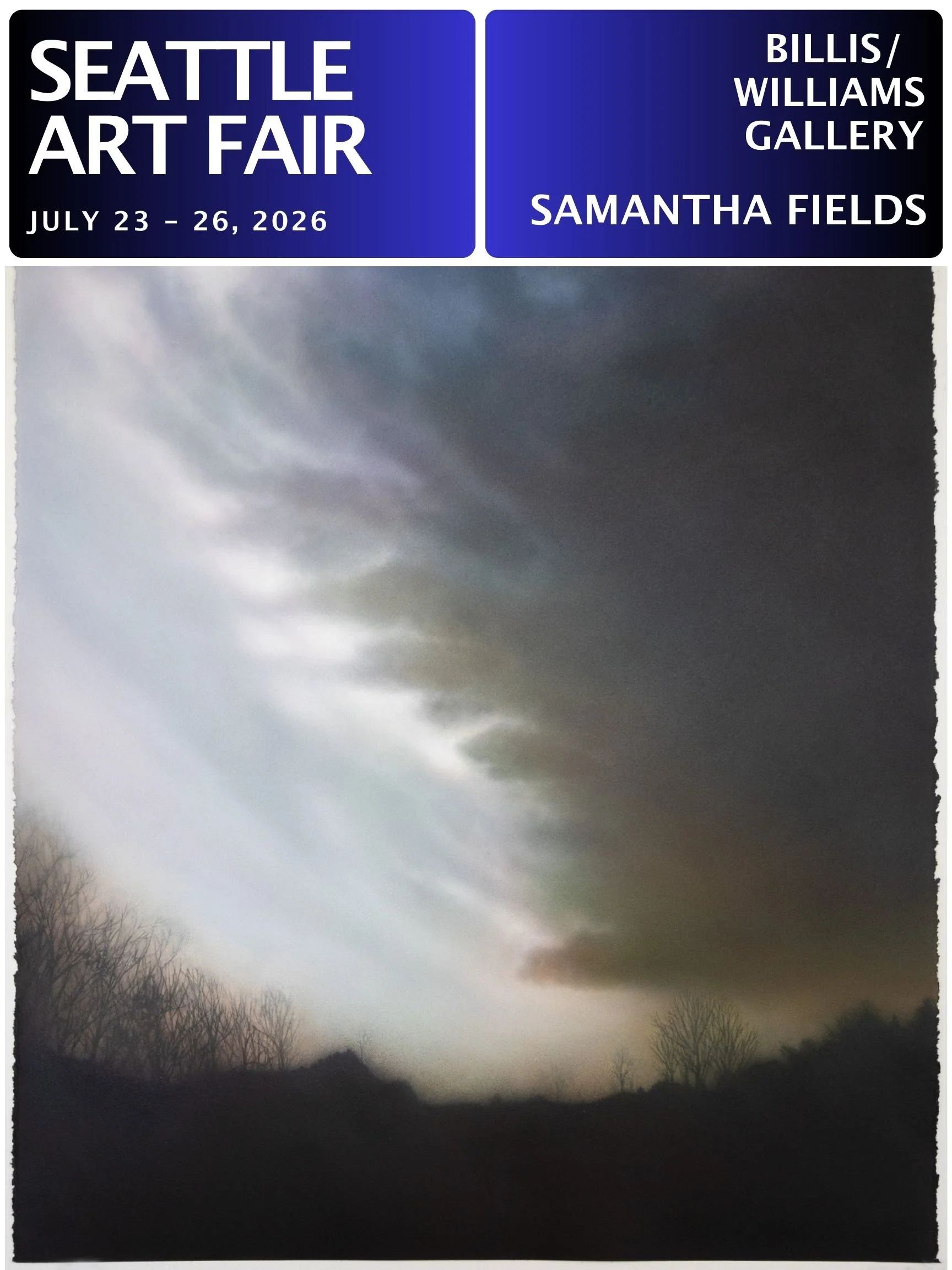
Seattle Art Fair 2026
Seattle Art Fair, a one-of-a-kind showcase for the vibrant arts community of the Pacific Northwest, and a leading destination for the best in modern and contemporary art, returns for its tenth edition, July 23–26, 2026. Working alongside Beneficiary Partner Seattle Art Museum, Artistic Director Nato Thompson, and the fair’s dedicated Host Committee, the Seattle Art Fair, founded by the late Paul G. Allen, is a celebrated and productive week bringing together the region’s strong collector base, the Pacific Northwest’s top museums and institutions, and an array of innovative public programming.
Read More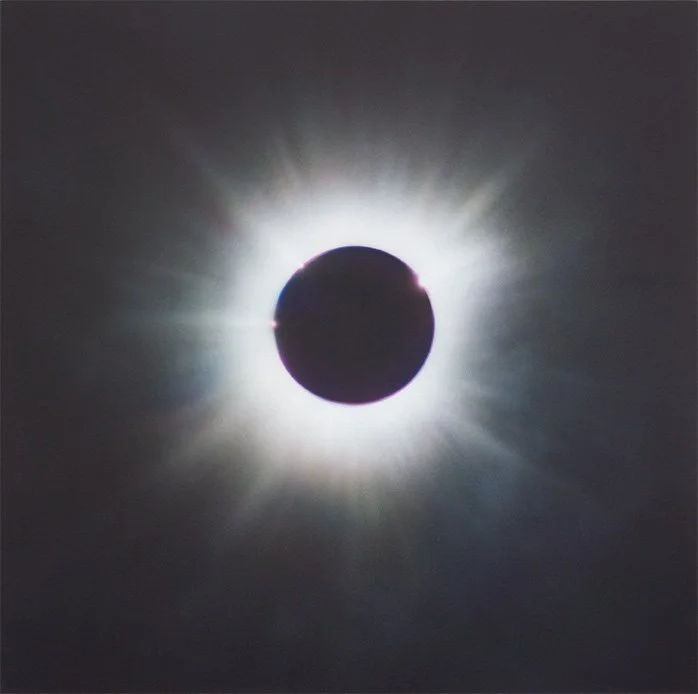
Portents at Traywick Contemporary
https://www.traywick.com/exhibition/samantha-fields-portents-2025/
January 18 – March 15, 2025
Traywick Contemporary is thrilled to present Portents, a new exhibition of paintings by Samantha Fields. In this compelling body of work, Fields delves into themes of impermanence, perception, and the fleeting nature of time, capturing the ineffable qualities of the natural world as it evolves rapidly and unpredictably. Through her signature painting technique, Fields’ photo-realistic style transforms everyday moments into enigmatic scenes that explore both the wonder and unsettling qualities of our existence.
Portents evokes a fractured world slipping away—a reality that is constantly in flux and slipping just out of reach. Fields uses the metaphor of celestial phenomena, such as a total solar eclipse, to articulate this elusive feeling. “A total solar eclipse,” she says, “is an uncanny alignment that casts day into night, momentarily unraveling the fabric of reality itself… an experience both wondrous and deeply unsettling.” These moments of cosmic alignment, both fleeting and profound, mirror the transitory experiences Fields captures in her paintings.
In her artistic practice, Fields focuses on capturing nature through veils and lenses — car windows, fog, smoke, rain, and the night itself all act as filters that separate her from the world. “In my paintings,” Fields explains. “I am less focused on clarity than on the experience itself. Often, the imperfect photographic elements—lens flares, light leaks, and subtle distortions—that best capture the fragility and transience of perception. They remind us that what we see is fleeting, fragmented, and vulnerable—capturing the impermanence of both the physical world and the act of seeing itself.
Southern California writer Annie Buckley, in her essay for Fields’ C.O.L.A. project, writes, “She transforms the everyday into something magical, a feat, to be sure; but more important… is the way the painting becomes something that is neither here nor there, not the journey nor the process, but a finite and distinct collision of light and time and memory catapulted slowly and carefully into being.” This collision of light, memory, and time is key to the emotive power of Fields’ work.
Fields’ paintings invite viewers to step into these fleeting moments—smoke lingering in the sky from nearby fires, city lights blurred by rain, blazing sun under oppressive heat waves, or the soft transition of shadows across a nighttime landscape. These transitory flashes—gone nearly as soon as they begin—speak to the ephemeral qualities of both time and beauty. Fields’ use of photographic techniques in her paintings, such as light leaks and lens flares, reinforces the idea that the world is always shifting, always on the verge of disappearing.
Samantha Fields lives and works in Los Angeles, where she is currently a Professor and Chair of Art and Design at California State University, Northridge. She has received numerous awards and professional recognition, including a prestigious City of Los Angeles (COLA) Individual Artist Grant. She has an extensive exhibition history and her work has been collected by and exhibited at noted public institutions such as the Fine Arts Museums of San Francisco, CA; Crocker Art Museum, Sacramento, CA; Stanford University Health Care, Stanford, CA; the University Art Museum, CSU Long Beach, CA; Armory Center for the Arts, Pasadena, CA; Cranbrook Academy of Art Museum, Cranbrook, MI; Jones Center for Contemporary Art, Austin, TX; and the Irvine Fine Arts Center, Irvine, CA. She has been represented by Traywick Contemporary since 2012.

Portents Review by DeWitt Cheng
https://www.visualartsource.org/post/samantha-fields-portents-dewitt-cheng
Traywick Gallery, Berkeley, California
Continuing through March 15, 2025
February 8, 2025
The British Romantic landscapist John Constable (1776-1837) once declared, “It will be difficult to name a class of landscape in which the sky is not the keynote, the standard of scale, and the chief organ of sentiment.”
Samantha Fields’ exhibition of recent paintings, “Portents,” with their multiple layers of airbrushed pigment, focuses on the skies of Fields’ Los Angeles as their “chief organ of sentiment.” In the 21st century this organ is one brought about by natural forces subject to physical laws, not the judgments of celestial overseers. Even without God in his heaven, however, the skies retain their fascination and awe. Fields has returned to the skies — and their associated clouds, fog, celestial bodies, fires, and fireworks — after a transitional period of domestic interiors realized during the pandemic lockdown.
“Portents” includes eleven medium-sized to small paintings, all derived from “failed photographs,” i.e., flawed snapshots, replete with photographic ‘mistakes,’ like lens flares, but adapted and perfected during the artist’s lengthy painting process. All are beautiful and mysterious, all imply something that is not yet evident, the promise of a withheld or ambiguous revelation, as Jorge Luis Borges put it. In the aftermath of the recent wildfires, a subject that the artist has explored before, it is easy to interpret the paintings secularly as environmental warnings to Angelenos to get our minds right about rebuilding in the naturally fire-prone Southern California ecosystem, especially given our poisoned political culture.
The gallery notes that “Portents” evokes a fractured world that may be slipping away — a reality that is constantly in flux and just out of reach. “Fields,” they assert, “uses the metaphor of celestial phenomena, such as a total solar eclipse, to articulate this elusive feeling.” The transient phenomena of the natural world are thus caught and preserved in paintings that freeze and condense time for our leisurely contemplation. “Portent,” the show’s eponymous painting, depicts a dust storm or tornado as seen from afar, darkly foreboding swirling masses of muted color that evoke recent natural twister disasters in the American south. Looking at this ominous image I could easily imagine the desperation felt by pre-scientific people who anthropomorphized such brutal force in order to explain it.
“The Path of Totality” presents a wide-angle view of a total eclipse, with the blacked-out sun at the top encircled by an aureole of clouds, and echoed by a tiny sun at the bottom, just above the dark horizon — a scientific anomaly, given poetic license: the heavenly and earthly realms suggest the Latin ut supra ut infra, as above, so below, and the bipartite composition of Raphael’s “Transfiguration.” “Prominence” and “Cathedral” focus on the blackened solar disk in eclipse surrounded by clouds. In reality, the danger of eye damage prohibits us from staring at a solar eclipse without eye protection. Fields’ image allows us to stare fixedly, the black disk metamorphosing into our eyes’ pupils, as in Magritte’s 1928 painting, “The False Mirror.”
Fields depicts doubled celestial bodies in “Twin Solo,” with its overlapping Venn diagram of partial eclipses, and “The World Is Not as You See It,” with its twin crescent moons, one seen from a clearing in the cloud cover, and the other seen through it. In “Whole Sky” and “A Light Hurt” the bokeh balls or lens flares beloved of photographers multiply, suggesting optical phenomena like auroras and glories, sun dogs and moon dogs, all of it spiritualized.
Fields’ paintings, with their mood of quiet absorption, are also reminiscent of the skyscapes of Caspar David Friedrich, with their rapt, enchanted viewers turning their backs on us. Fields reminds us that we are now those silent witnesses to the mystery of the universe, reminded once again that we and our culture are part of nature, not always its masters but its subjects. We are not inevitably — as the status-quo fatalists rationalize — victims of our own nature. As Shakespeare’s Cassius says in “Julius Caesar:” “The fault, dear Brutus, is not in our stars, but in ourselves, that we are underlings.”
DeWitt Cheng is an art writer/critic based in the San Francisco Bay Area. He has written for more than twenty years for regional and national publications, in print and online, He has written dozens of catalogue essays for artists, galleries and museums, and is the author of “Inside Out: The Paintings of William Harsh.” In addition, he served as the curator at Stanford Art Spaces from 2013 to 2016, and later Peninsula Museum of Art, from 2017 to 2020.

Facing Fire at the Nora Eccles Harrison Museum of Art →
Facing Fire:
Art, Wildlife and the End of Nature in the New West
July 8 - December 16, 2023
Fire as omen and elemental force, as metaphor and searing personal experience—these are thesubjects explored by the artists ofFacing Fire.California’sdiverse ecologies are fire-prone, fire-adapted,even fire-dependent. In the past two decades, however, West Coast wildfires have exploded in scale andseverity. There is a powerful consensus that we have entered a new era. The artists ofFacing Firebringus incendiary work from active fire lines and psychic burn zones. They face fire, sift its aftermath, andstruggle with the implications.
This exhibition has been curated by Douglas McCulloh and organized by UCR ARTS: California Museum of Photography. Artists include: Noah Berger, Kevin Cooley, Josh Edelson, Samantha Fields, Jeff Frost, Luther Gerlach, Christian Houge, Richard Hutter, Anna Mayer, Stuart Palley, Norma I. Quintana, and Justin Sullivan.

Women's Issue: Artillery Magazine →
Samantha Fields
Samantha Fields’ paintings unfold along a darkly fanciful and increasingly multifaceted continuum of disaster and perception in storm fronts, fires, abandoned dreams and other metaphors for societal decline, mediated by uncanny photographic intercessions. She’s currently painting storms—their violent clashing and cleansing suits the era, and opportunities to expand her jewel-toned naturalism are many. She started on them
pre-lockdown, after photographing multi-tornadic phenomena in Texas. When everything changed—BLM, the lengthening pandemic, the insurrection, massive wildfires—she turned instead to the “American Dream” paintings: landscapes of winter’s discontent festooned in confetti and party balloons.
Recently, in Texas again, she photographed myriad storms which will be on view at Rory Devine Fine Arts in October. Her prismatic “Worlds Within Worlds,” based on dreamlike, anxiously shifting photos of her own backyard, were shown this summer at Berkeley’s Traywick Contemporary, and her affecting wildfire paintings are in two institutional shows this year. Along the way she became chair of the art department at California State University, Northridge—the first woman to hold the post—where she’s focusing on access, interdepartmental collaboration, and local and international exchanges. “When I came on board,” she says, “I kept asking, ‘Can I do this? Can I do that?’ and the answer was always, ‘You can do whatever you want.’ So, hell yeah, let’s do all the things!”
––Shana Nys Dambrot

Solace/Sublime at The Angels Gate Cultural Center →

Sense of Place at the Strohl Art Center →
Sense of Place
JUNE 25 - JULY 23
Strohl Art Center | Main Galleries | Opening reception June 25, 3-5pm
Sense of Place is a non-traditional landscape exhibition that considers our relationship to place. These works conjure more of an aura than an illustration of a particular location. Through painting, textiles, photography, and ceramics, they explore the interconnectedness of earth, water, and air. They question our responsibilities to and our place within the landscapes we inhabit. They document, dissect, imagine, and tend to these spaces. Sponsored by the Jerome M. Kobacker Foundation. Curated by Erika Diamond. Artists: Marifer Fernanda Barrero, Samantha Fields, Liz Nielsen, Mika Obayashi, Hồng-Ân Trương and Lien Truong.
Read More
Night Comes Early @ rdfa →
Reception: 10/22/22 from 4-7pm
NIGHT COMES EARLY: Samantha Fields
Before everything was canceled, I took one last trip to Texas. It was October 2019, and unseasonable storms rolled through, dropping tornadoes and lightning on a swath that swept from my in-laws house to my husband's hometown of Garland. This was a precursor, I thought, to the storm chasing trip I was planning to make that summer.
By Christmas, there were already media stirrings of a virus that was ravaging Wuhan, China. Soon, that virus had a name, and it was here, and I wasn’t going storm chasing. Fast forward to the post-vax world and I was in a car with my husband Andre, driving once again to Texas. This time it was tornado season, with one supercell after another marching across the flat and otherwise empty landscape. Andre drove the car and I shot out the window and I thought over and over again that I would love to drive forever, we could just keep going and going, the landscape unfurling ahead of us, a new vista every second….a visual feast after a year of seeing nothing but our own backyard.
My last trip pre-covid, and my first trip post-vax were to Texas, both serving up storm after storm, as if this broken world was giving me the trip I’d canceled. Maybe you don’t need to chase something that’s placed in your path.
We are bombarded with catastrophic images of severe weather in the media. My work deals with the same content, but these paintings are made from my own experiences, culled from wherever I happen to be. The slow apocalypse of climate change is with us every day; from heat waves, wildfires, grid failures, and floods, to storms rolling across the roads we travel with our beloveds. I’m interested in the daily, ongoing signs that are screaming at us, like the cursed Cassandra, that the end is surely near. But this world has a skin that looks the same as it ever was, and even shared moments of alarm recede into the bread and circuses that fill our days and our feeds and we march one step closer to our assured end.
Read MoreTraywick 25th Anniversary: Limited Edition Print to benefit Reproductive Rights
Samantha Fields: Scope, a limited edition print
For the 5th release from the gallery’s 25th Anniversary fundraising project, we are pleased to offer Scope, by Samantha Fields: a limited edition print featuring an image specially selected from the artist’s rarely seen photography archive. Depicting a glowing palm tree haloed by rings of sunlight, and reflected through the echoing lens of a scope, this work reveals the transformative properties of light as seen through ephemeral occurrences. As in her larger practice, Fields immerses the viewer in landscapes that embrace both fact and fiction, recreating the energy and emotions of fleeting moments. Continuing our support of reproductive freedoms and equitable access to health care, 50% of sale proceeds from the release of this print series will be donated to reproductive rights organizations like Sister Song and Planned Parenthood. Released June 2022.25th Anniversary. Art for Change.
Throughout the year we will be releasing multiples and editioned work, created by gallery artists to mark the occasion. Sale proceeds from these releases will be donated to groups like Planned Parenthood and Sister Song, that advocate for reproductive justice and freedom, ensuring access to the care and resources all people need to make informed decisions about their bodies, their lives and their futures.
Where We Are Now at Traywick Contemporary
Recent work by Samantha Fields, Benicia Gantner and Coleen Sterritt June 11 - August 6, 2022
Traywick Contemporary is pleased to announce We Are Now, an exhibition of recent work by three California based artists: Samantha Fields (Los Angeles), Benicia Gantner (Marin County) and Coleen Sterritt (Los Angeles).
Reminiscing about time spent and time lost, this exhibition explores our changing world as we look back over the recent past, and think ahead to what the future might hold. Each artist relies on real-world materials and imagery to create work that reflects shared experiences through observational study of daily life. Suggesting moments of transition, their work encourages viewers to look more closely at the fragile world around us, and to experience firsthand the possibility of transformation.
An artist that typically relies on travel for her creative process, Samantha Fields looks for the changing light and shifting atmosphere of specific locations in her attempts to capture the ineffable in her paintings. Confined to home during the pandemic, Fields began looking to the outer world from her windows, to escape her confines through the pinpoint-focused view of scopes, which in turn introduced new vistas swimming in color and light. The experiential nature of Fields’ paintings immerses the viewer in fleeting moments: smoke lingering in the sky from nearby fires, the blur of city lights reflected on wet pavement, the blazing sun in unprecedented heat waves, or transient shadows shifting across a nighttime landscape. The transitory flashes she depicts in her paintings – gone nearly as soon as they begin – speak to the ephemeral qualities of both time and beauty.
Facing Fire at UCR Arts Block: Interview
Interview with Douglas McCulloh
Samantha Fields is a disaster artist. “Disaster, from massive storms and wildfires to political collapse and personal tragedy, fascinates and troubles me.” Fields’ paintings are an inventive update of traditional allegorical landscape painting: ominous vistas and environmental calamities portrayed with a deadpan, analytical accuracy that underlines the fragility of life and the certitude of death and disaster. The wildfire paintings are based on her own photographs. Of late, she says, she can pick and choose among Southern California conflagrations. Some have been close by her own southwest-facing hillside house in the Mount Washington neighborhood of Los Angeles.
Fields presents the viewer with images of mysterious manufacture. “I paint atmosphere with atmosphere,” she says. There is no touch of hand, no texture of paint. She sprays coat after coat of vaporized acrylic paint onto super smooth canvas. “It takes hundreds of layers to create the paintings, which while photographic, deny the accuracy of that medium upon closer inspection.” In the end, the paintings feel as shadowy as the drifting blurs of vapor, smoke, and haze they reference. Their gossamer, ethereal quality invokes the sublime. But the tenuous insubstantiality undermines certainty, questioning the veracity of photography, of memory, of perception itself.
Another Year in LA: 6' Apart, in it Together: Samantha Fields & Cole Case →
For our Summer exhibition, “6’ Apart – In It Together”, we are featuring two Los Angeles-based artists who have been making work this year that address both sides of the pandemic isolation orders.
Cole Case, paints images that are devoid of humans except for residual evidence of their actions. Bagged groceries that have been delivered are seen through a glass door or products placed out on a table outside to quarantine before they can be brought in the house. The way that Case presents these commonplace images become haunting reminders of the world in which we live. There is a deep sense of pathos and loneliness in his paintings on paper.
Samantha Fields’ aerial view paintings, on the other hand, of multitudes of people seen congregating on ocean beaches have an immediate sense of doom because of the possibly of their spreading the Covid-19 due to their lack of social distancing. What would have been playful images, a few months ago, of throngs frolicking on the beaches are now horrific because we are knowledgeable that this invisible virus can be anywhere. The aerial imagery gives us a forced distance from those on the beach which imposes a lack of individuality; so those depicted are just flecks of paint and not men, women and children.
Artists respond to their times and the social/physical environments of those times. Cole Case and Samantha Fields paintings are remarkable documents of our 2020 Pandemic Stay-At-Home era.
Riot Material: Another Week in the Death of America by Eve Wood →
The first verse of the Mamas and the Papas seminal 1960’s anthem California Dreamin’ begins with “all the leaves are brown, and the sky is grey,” at once establishing an atmosphere devoid of color, hope and youthful abandon, and certainly not a description one would associate with the sunny, carefree lifestyle that has become emblematic of the quintessential California experience. Ultimately the song is a lament, a yearning to return to a brighter, more hopeful landscape, if only in the songwriter’s mind. Samantha Fields solo exhibition, American Dreaming, could be said to expand on this longing, albeit taking a darker more ominous approach.
Read MoreArt & Cake: American Dreaming or American Nightmare by Lorraine Heizman →
The suite of ominous paintings by Samantha Fields at LSH CoLab tell a story about America in decline, where promises are destroyed and scattered like confetti in a ticker tape parade. Depicting natural disasters and explosive accidents, Fields deftly turns tragedies into dramatic allegories, creating a dark portrait of our country’s damaged psyche that might be even timelier now than when the artist began this body of work in 2018.
Read MoreLA Weekly Art Pick: by Shana Nys Dambrot →
Los Angeles painter Samantha Fields gained recognition for her lovingly rendered images of disasters and disorientations in the natural landscape and built environment — fires, floods, tornadoes, and the like. But since 2016, her concept of destruction has expanded to include the chaos and confusion rampant in this chapter of our social and political history. While her iconography and palette intensified, the images have remained metaphorical, with emotions evoked and Cassandra-like warnings issued, and dark humor abounding as a strategy for staying sane.
Read MoreArt & Cake Review of Girl Crush →
The show features a variety of styles and techniques, but the art is united by a common sense of mood, place, and color. Stephanie Kelly Clark’s amazing embroidered needlework looks at first glance like pastels. Lisa Golightly’s deceptively simple beach scenes have the soft gauze of a hazy memory. Samantha Fields tiny paintings capture the grim beauty of forest fires. Stephanie Vova’s photographs invoke the washed-out colors of an old seventy’s movie starring Gene Hackman or Nick Nolte.
Read MoreArt For Your Ear: Interview with The Jealous Curator, Danielle Krysa
Here's a brand new interview with The Jealous Curator Danielle Krysa, where we talk about childhood, how I moved to LA, being married to another artist, teaching, and of course, the paintings. You can also find out if I prefer to swim with shark or hold snakes. ;)
You can listen here: http://www.thejealouscurator.com/blog/2017/03/10/if-im-in-the-zone-leave-me-alone/
Or you can download Danielles podcast on itunes at Art For Your Ear, I recommend it, there are over 90 inspiring talks to listen to, and Danielle always asks great questions.